
What is a 0DTE option?
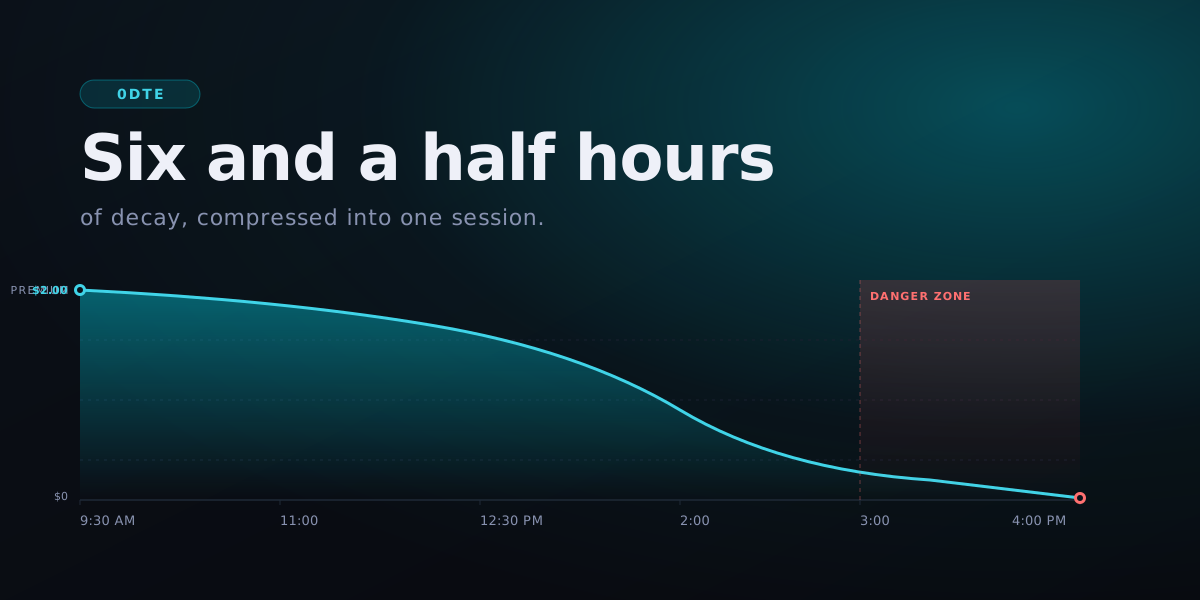
A 0DTE option is an option contract that expires the same trading day you buy or sell it — usually within hours, sometimes minutes — with a price that swings dramatically as the closing bell approaches.
Picture an options contract sold at 10am that expires at 4pm. Six and a half hours of life. Six and a half hours for the underlying to do whatever you think it's about to do, with no carry-over to tomorrow and no “maybe it'll work next week.” Compared to the 30-to-45-day contracts most retail education talks about, a 0DTE compresses every options dynamic into a single session — and that compression is most of what makes them feel different to trade.
The acronym stands for “zero days to expiry,” and 0DTE has become shorthand for any same-session option whether you opened it that morning or held it from a longer-dated position into the final day. The Greeks article described theta as a faucet slowly draining the bathtub. On a 0DTE that faucet is a fire hose, and you're holding a sieve.
Why they exist, and why they exploded
0DTE options exist because Cboe added daily expirations to the SPX and a handful of major ETFs starting in 2022 — letting traders bet on intraday moves directly rather than buying a longer-dated contract and praying for the move to happen quickly.
Before 2022 the shortest practical option on most major underlyings was a weekly — Friday-expiring, with about five days of life when it opened on the previous Monday. Cboe rolled out daily SPX expirations through 2022, expanded to QQQ and SPY shortly after, and the volume curve hasn't flattened since. By early 2026, 0DTE contracts make up 59% of all SPX volumeand roughly 1.5 million contracts trade every day in this single bucket. Retail picked them up through TikTok, r/wallstreetbets and a generation of YouTube finfluencers; institutions picked them up because they're an extraordinarily cheap way to hedge a portfolio overnight.
The mechanical reason the volume followed is leverage per dollar: a 0DTE option costs a fraction of a 30-day option on the same strike, because most of an option's extrinsic value comes from time and a 0DTE has almost none of that left. A $20 premium on a 30-day contract might be 40 cents as a 0DTE — and the same absolute stock move pays the same absolute dollars on either, which means the percentage return on the 0DTE is mathematically much larger when it works. That asymmetry is the entire pitch.
What they feel like to hold
Holding a 0DTE option is every options dynamic dialled up at once: theta drains by the minute, gamma swings violently around the strike, and small stock moves create disproportionately large option-price moves — all on a clock that doesn't stop.
Theta at this scale isn't subtle. A $0.80 0DTE option at 10am can be $0.60 by 11am and $0.30 by 1pm if the stock just sits, and the decay accelerates the closer expiry gets. By 3pm the option is almost pure intrinsic value — the time premium is essentially gone — and an at-the-money contract is making its mind up between worthless and a few cents in the final half hour. The position you opened at breakfast may not resemble what you have at lunch.
Gamma is the other side of the same coin. Gamma measures how fast delta itself is changing, and gamma hits its lifetime maximum on expiration day on at-the-money strikes. A small stock move that would have been a 5-cent option move on a 30-day contract becomes a 30-cent move on a 0DTE — both directions. You can be up 80% by 11am and down 40% by 12:15pm on a single $0.50 underlying reversal. Most retail blowups on 0DTEs aren't from being wrong on direction; they're from being right on direction and not getting out of the trade before the next intraday wiggle.
What can go wrong
0DTE trades fail in three predictable ways: theta drains a near-the-money option even when you're “right” about direction, gamma whipsaw flips a winner into a loser in minutes, and end-of-day liquidity dries up exactly when you need to close.
The headline failure is the “I was right but lost money” trade. SPY opens at $500. You buy the $502 call at 10am for $0.80. By 2pm SPY is at $502.50 — you were directionally correct — but the option is now worth $0.60 because theta has eaten the extrinsic value faster than the move added it back. SPY finishes the day at $502.30, your call expires $0.30 in the money, and you collect $0.30 a share on a contract you paid $0.80 for. Right direction, wrong magnitude, and the structure couldn't carry the small win across the clock.
The quieter failure is the gamma whipsaw. You buy the same $502 call at 10am for $0.80; SPY rallies to $503 by 11am and your call is worth $1.70. Excellent. You hold “just a bit longer” — SPY reverses to $501.50 by 12:30pm and your call is back to $0.20. Same instrument, same day, more than two-thirds of the premium round-tripped in ninety minutes on a one-and-a-half-point underlying swing that any other day wouldn't even register.
The third failure is liquidity. Bid-ask spreads on 0DTE out-of-the-money strikes widen dramatically in the last 30 minutes — sometimes from a penny wide to a dime wide on the same contract — because market makers don't want overnight gamma exposure on something that'll be worthless in twenty minutes. You may not be able to close at anywhere near the midpoint, and on a cheap option that's the difference between a small win and zero.
Who's actually trading them
0DTE volume splits roughly 50/50 between retail traders looking for a quick directional bet and institutions using them as low-cost intraday hedges — and the difference in why each side shows up matters more than most retail education admits.
The retail half is mostly small accounts buying calls or puts on SPX, QQQ or a handful of high-beta single names like NVDA and TSLA, sized as a lottery ticket — a few hundred dollars on a cheap OTM strike, paid for with the assumption that one in five of these will hit big enough to cover the four that don't. Some of those traders are disciplined. Most of the ones posting about it on TikTok are not, and the surviving subset that actually beats the market is statistically tiny.
The institutional half is doing something completely different. Pension funds and asset managers buy 0DTE puts on SPX the afternoon before a Fed meeting or a CPI print to hedge their existing equity exposure overnight — cheap insurance that expires the next day either useful (CPI hot, market drops, the put pays out) or worthless (CPI in line, market drifts, the $0.40 was the cost of sleeping). Dealers and market makers trade 0DTEs to manage their gamma exposure on the rest of their book. The flow these counterparties create is enormous and directionally agnostic; it can swamp any “edge” a retail directional trader thinks they have within minutes.
When (if ever) does a 0DTE fit?
0DTE options fit narrowly: a clear directional view on the next few hours, position-sized so the trade is a defined-loss bet rather than a portfolio bet, on a high-liquidity underlying like SPX or QQQ where the chain isn't a ghost town.
Three constraints all have to be true at once. First, the thesis has to fit inside the trading day — “Powell's speech at 2pm will move SPX a percent in either direction” is a 0DTE thesis; “NVDA looks toppy” isn't. Second, the size has to be defined-loss money: the entire premium you paid should be money you'd be comfortable lighting on fire, because zero is the most common outcome. Third, the underlying needs to actually have a 0DTE chain with tight spreads — SPX, SPY, QQQ, NDX and a few major single names qualify; most stocks don't have daily expirations at all.
Where 0DTEs don't fit is everywhere else. Don't add them to a portfolio strategy that needs days or weeks to play out — you're mixing time horizons in a way the math won't reward. Don't trade them on illiquid names where the chain is bid $0.10 / ask $0.50 on a contract that should be a nickel wide — you're paying the spread as rent. And don't size them like position trades; a 5% of portfolio bet on a 0DTE has wiped out more retail accounts in the last two years than any other single mistake in options.
A quick word on taxes (US)
0DTE options on broad-based indexes like SPX, NDX and RUT are taxed under Section 1256 — a 60% long-term / 40% short-term blended rate that's significantly better than the ordinary income treatment ETF options get.
SPY, QQQ and other ETF-based 0DTEs are taxed as short-term capital gains at ordinary rates (up to 37%), which on a trader running hundreds of intraday round-trips a year can be a serious drag. SPX-style index 0DTEs get the 60/40 blended treatment by default. The math difference is large enough that a lot of active 0DTE traders shift their volume to SPX or NDX specifically for the tax treatment — even though the dollars per contract are bigger and the strikes look unfamiliar at first. None of this is tax advice; talk to a CPA who actually knows Section 1256 before optimising around it.
Try it with paper money first
The most useful first 0DTE trade is one you never actually fund — open your broker's paper-trading account, write down a thesis at 9:30am, place the order, and watch what happens for a month before risking a real dollar.
The numbers in this article look reasonable on paper. The experience of watching a $200 position swing from +$180 to −$160 and back to −$50 over thirty minutes is genuinely different from reading about it, and there's no substitute for sitting through that loop fifteen or twenty times before deciding whether 0DTEs belong in your toolkit at all. If you do decide they do, plug your candidate strikes into the break-even calculator with a 1-day expiry to see where the trade actually turns green — which on a typical 0DTE long-call setup is much further OTM than beginners expect.