
What happens when an option expires?
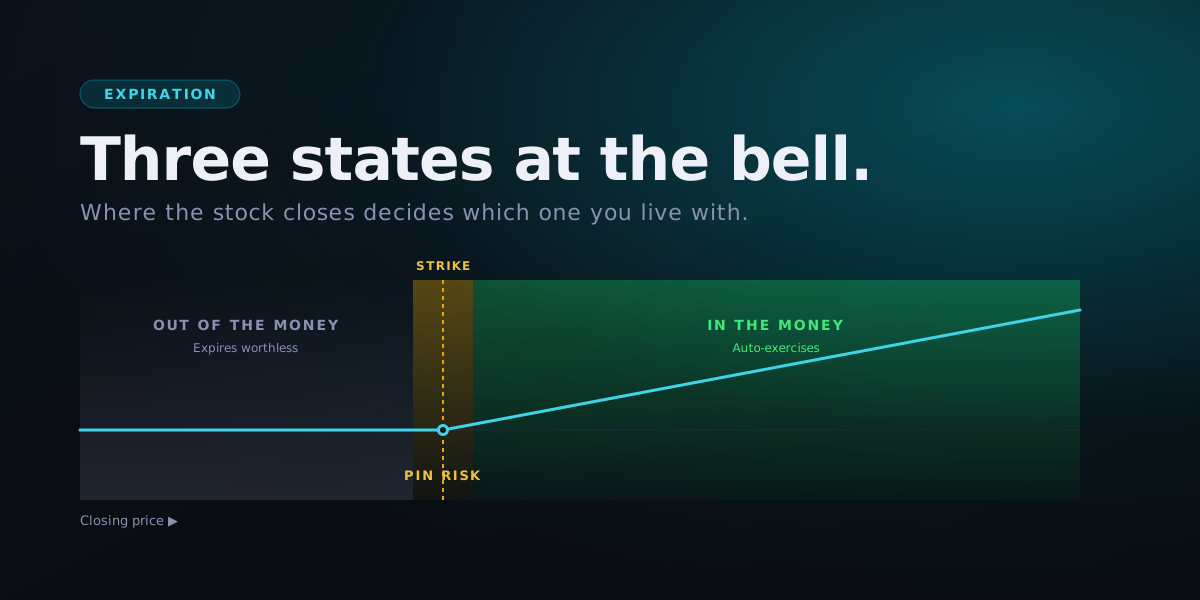
When an option expires, one of three things happens depending on where the stock closes relative to the strike: it's automatically exercised (in-the-money), it expires worthless (out-of-the-money), or it sits right on the strike and creates what's called pin risk.
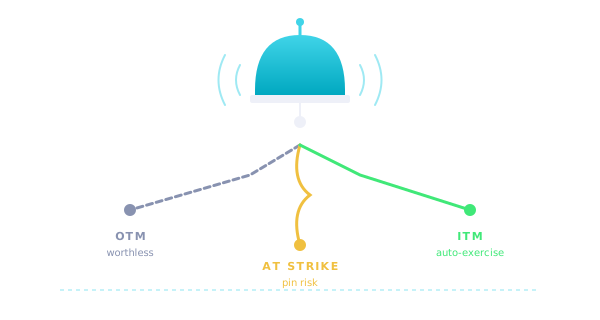
Most retail traders treat “expiration” as a single event — the option goes away on Friday, full stop. It's actually three mechanically different events, and which one happens to your specific contract depends entirely on where the underlying closed at the bell. Think of the closing bell as a photo finish: the strike is the finish line, and where the stock is when the bell rings decides whether you collect, walk away empty-handed, or get a phone call from your broker on Monday morning explaining what happened over the weekend.
The three states are in-the-money, out-of-the-money, and right at the strike. The rest of this article walks through each of them in plain English plus the failure modes most retail traders only learn about after their first bad weekend.
In the money: the option exercises automatically
An option that closes in-the-money at expiration is automatically exercised by your broker — for calls, you buy 100 shares at the strike; for puts, you sell 100 shares at the strike — and there's no opt-in step the holder needs to take.
Say you bought a $500 SPY call expiring this Friday. SPY closes the session at $501.50. Your call is $1.50 in the money. After the bell, the Options Clearing Corporation (OCC) flags your contract for automatic exercise; on Monday morning your account shows 100 shares of SPY at a cost basis of $500 a share, with $50,000 of cash debited to pay for them. You profit $150 if you sell those shares immediately at Monday's open assuming the price hasn't moved overnight — minus whatever you paid for the call originally — and the contract itself disappears.
For a put, the mirror image: you owned a $200 put on a stock that closed Friday at $198. The put exercises automatically. Monday morning you're short 100 shares at $200 a share — meaning you sold them — and you have a corresponding $20,000 cash credit in the account, minus the premium you paid for the put up front. From there you can buy the shares back at the market price and keep the difference, or hold the short position if your broker and account permit it.
The automatic-exercise rule applies as little as $0.01 in the money. There's no “close enough” threshold and no human review — the OCC's system flips the switch any time the closing price crosses the strike by even a penny, unless the holder explicitly filed a contrary instruction by their broker's Friday-afternoon cutoff (usually around 5:30pm Central). Most retail traders never know that opt-out path exists; most never need to.
Out of the money: the option expires worthless
An option that closes out-of-the-money at expiration expires worthless — the contract simply ceases to exist, the buyer loses 100% of the premium they paid, and the seller keeps the premium they collected.
This is by far the most common outcome — somewhere around 70-80% of all options expire worthless on the buyer side, depending on the study you trust and how you slice the data. There's nothing for the holder to do. No exercise, no settlement, no shares change hands; the contract disappears overnight and the line item drops out of the account on Monday morning. For the seller — the trader who wrote the option and collected the premium — this is the outcome they were rooting for the whole time. The maximum profit on a long option is unlimited (calls) or capped at the strike (puts); the maximum profit on a sold option that expires worthless is the entire premium, realised in full at the bell.
Right at the strike: pin risk and the danger zone
When an option closes within pennies of its strike at expiration, the holder faces “pin risk” — the uncertainty about whether the option will be exercised, made worse by the fact that the stock can still move in after-hours trading and over the weekend before the exercise actually settles.
Say your $500 SPY call closes the regular session at exactly $500.05 — five cents in the money. Technically your option auto- exercises. You acquire 100 shares at $500 over the weekend. Then Monday opens at $497 on news that broke Sunday night, and your positions show a $300 paper loss before you've had coffee on a trade you thought had basically expired worthless. The five cents of intrinsic value at Friday's close became a -$3 weekend move that you had no way to hedge against, because you'd already been exercised.
The same risk runs in the other direction for sellers. You sold a $105 covered call on a stock that closed at $104.95 on Friday — seemingly safe, the call should expire worthless and you keep the premium plus the shares. But the stock prints $105.10 in after-hours trading on a late headline, and now you don't know whether the option holder filed an exercise notice. Monday morning you may or may not still own your shares; you find out from your broker. This is the scenario every covered-call seller thinks about and most learn about the hard way.
What can go wrong
Three things commonly go wrong at expiration: insufficient cash to cover an unexpected assignment, an overnight gap that turns a profitable ITM exercise into a loss, and the seller getting assigned on a short option that everyone thought would expire worthless.
The cash-crunch failure is the most painful for retail. You bought a $200 put on a $250 stock and it crashed to $150 on Friday — wonderful, you're deeply in the money. Your put exercises automatically and Monday morning shows a short position in 100 shares of the stock, with $20,000 needed in cash to cover. Your account has $4,000. The broker liquidates the position at the open for whatever price is available, which may be worse than the closing print Friday, and the “wonderful” trade settles at noticeably less than the on-paper Friday math suggested.
The overnight-gap failure looks like the pin-risk example above but bigger. Friday close: SPY at $501 on a $500 call. You're $100 in the money on the contract and feeling good. Sunday evening a geopolitical headline lands; SPY futures gap down 2% overnight. Monday opens at $491 and your auto-exercised call produces a $900 paper loss on a position you thought was a clean win at 4pm Friday.
The surprise-assignment failure is the seller's version. You sold a credit spread expecting it to expire worthless. The short leg closes at $0.02 in the money. You're assigned; your long leg, even though it was further OTM, may or may not be auto-exercised by your broker depending on its threshold (some brokers use $0.01, some use higher cutoffs that can leave the long leg unexercised). The result is a naked stock position you never wanted, sometimes overnight, sometimes for a weekend.
How to avoid the worst surprises
Three habits prevent most expiration accidents: close near-the- money positions before the Friday bell, keep enough cash to cover any assignment your shorts could trigger, and watch the full close rather than the 3:55pm snapshot.
Close near-the-money positions before the bell. If your option is going to settle within a dollar or two of its strike, the math on closing now versus letting it auto-exercise is almost identical — except the closed position has zero weekend-gap risk attached. Pay the small commission and the bid-ask spread to eliminate the surprise.
Keep cash to cover.If you're holding short options into expiration — a sold call, a credit spread, an iron condor — make sure the account has enough buying power to absorb the assignment if it happens. Most brokers won't let you open the position without that headroom in the first place, but if the account's drifted down through the week, the buffer may be thinner than you remember.
Watch the full close, not just 3:55pm.The stock's settlement price for expiration purposes is the official close, which can move in the final five minutes on index funds rebalancing or end-of-day order flow. A strike that looked safe at 3:55pm can flip ITM by the bell, and a strike that looked deep ITM can drift back to even more cleanly ITM. After-hours trading doesn't move the settlement price, but it does move the underlying you'll wake up holding on Monday.
Try it with the calculator
The fastest way to internalise these mechanics is to model what your P&L looks like at half a dozen possible closing prices around the strike.
Open the break-even calculator and plug in your position — a long call, a covered call, a credit spread, whatever you're holding into Friday. The payoff curve shows you exactly what each closing price translates to in dollars; the “at the strike” point is the one to stare at, because it's where the mechanics get interesting and where most beginners are surprised by the result. Five minutes with the calculator before expiration teaches you more than reading three more articles ever will.