
It looks scarier than it is
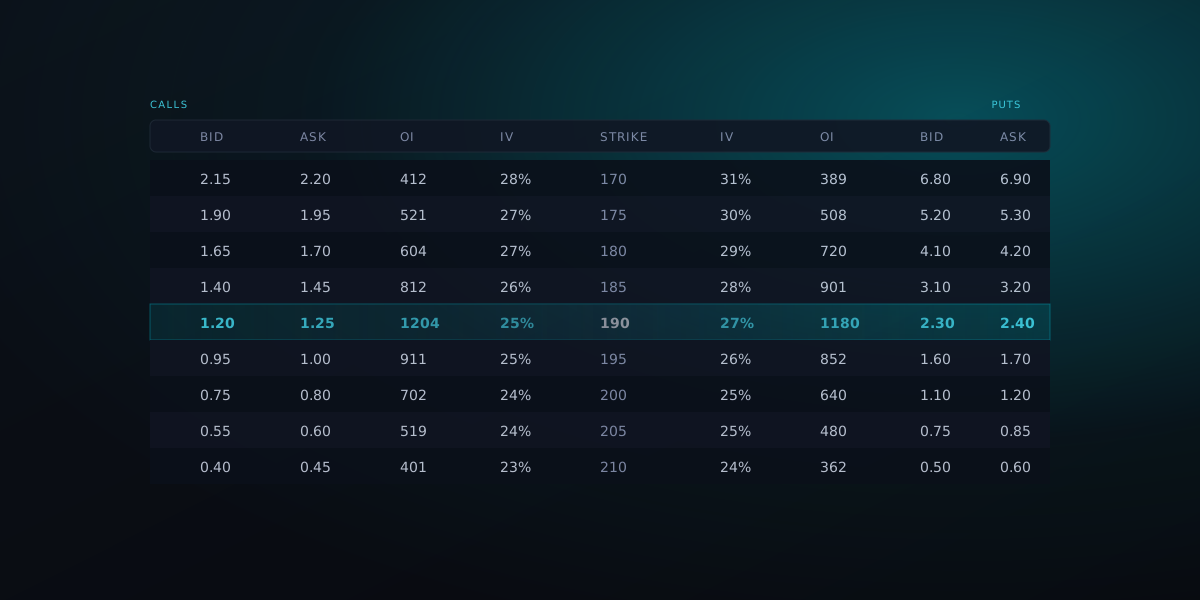
An options chain is a table of every available contract on a stock — strike prices down the middle, calls on one side, puts on the other, and a row of price-and-probability columns for each — and it looks like an airplane cockpit until you know which four columns to actually read.
The first time you open one, your eye darts across fifteen columns of numbers blinking in three different colours, and the impression is that every one of them must matter or the broker wouldn't have shown them. The truth is more generous than that. Most of what you see on day one is scenery — values an active trader might glance at twice an hour and a beginner can ignore for months. Four columns do roughly ninety percent of the work, and the rest of this guide is about which four they are and how to tell when one of them is lying to you.
The layout, in one paragraph
Every options chain has the same three pieces: a list of strike prices running down the middle, calls (the right to buy) on one side, puts (the right to sell) on the other, and a dropdown above it all that picks the expiry.
Picture a menu at a diner. The strikes are the price column on the menu — say $90, $95, $100, $105, $110 — and each strike has a row of options arranged on either side of it like dishes listed twice with different sauces. Calls live to the left, puts to the right; sometimes the layout is flipped, but the idea is the same. Above the menu sits a dropdown of expiry dates — weekly Fridays, monthly third Fridays, quarterly cycles, even leaps a year or two out. Pick a different expiry and the menu regenerates with a fresh set of prices for the same strikes. That's the entire layout, and once you see it as one menu with two columns and a date selector, the cockpit feeling evaporates.
The four columns that actually matter
Bid/ask, open interest, implied volatility and delta are the four columns that do almost all the work — they tell you what the option costs to trade, whether the market for it is liquid, how nervous traders are, and roughly how likely the contract is to finish profitable.
Most chains expose these four right next to the strike, with the Greeks tucked further out as toggleable extras. Read them in this order:
- Bid and ask are two prices side by side — the bid is what a buyer will pay you right now, the ask is what a seller is asking. Think of it like a used-car lot: the dealer buys low, sells high, and the gap is their cut. You want to trade near the midpoint of those two numbers, and you want the gap itself to be narrow. A wide gap means the market is thin and the cost of getting in and out will eat your premium before the trade has a chance to do anything.
- Open interest is the number of contracts that exist at that strike right now. High open interest is a busy market: lots of buyers and sellers, tight prices, easy entries and exits. Low open interest is a ghost town — you'll usually overpay to enter and underpay to leave, and on really thin strikes you'll sometimes find no counterparty at all when it comes time to close.
- Implied volatility (IV) is the market's guess at how much the stock will bounce around between now and expiry, expressed as an annualised percentage. High IV means options are expensive, low IV means they're cheap. Think of it as the umbrella price before a storm — everyone feels the same forecast, so when rain's on the radar the umbrellas get marked up, and when the sky is calm they go on sale.
- Delta is a rough probability that the option finishes in-the-money, and also tells you how much the option will move when the stock moves $1. A 0.30 delta call is loosely “a 30% shot at hitting” and gains about 30 cents for every dollar the stock rises. Delta is the column that translates stock moves into option moves, and once you internalise it the rest of the chain stops feeling so abstract.
| Bid / Ask | Open Int | IV | Delta | Strike |
|---|---|---|---|---|
| 1.85 / 1.90 | 521 | 27% | 0.72 | 175 |
| 1.45 / 1.50 | 812 | 26% | 0.62 | 180 |
| 1.15 / 1.20 | 1,204 | 25% | 0.52 | 185 |
| 0.88 / 0.92 | 902 | 25% | 0.41 | 190 |
| 0.62 / 0.68 | 702 | 24% | 0.31 | 195 |
ITM vs OTM — which side of the line
Most chains shade one half of the table to show which strikes are already profitable if the stock simply stayed where it is — those are in-the-money (ITM); the rest are out-of-the-money (OTM), bets that the stock has to move your way to pay off.
The line between them sits right at the current stock price, so if the stock is trading at $100 the 95 calls and 105 puts are both ITM and the 105 calls and 95 puts are both OTM. Scroll up or down from the line until you find the strike you want; the further OTM you go, the cheaper the option and the lower the probability it pays off, and the further ITM you go, the more the option behaves like the stock itself. New traders almost always overweight cheap OTM strikes and almost always underweight modestly OTM ones — the cheap lottery-ticket strikes win less often than the chain's pricing implies they should.
Expirations — short dates vs long dates
A single stock has dozens of expiries — weekly Fridays, monthly third Fridays, quarterly cycles, sometimes leaps a year or two out — and the right one depends almost entirely on how much time you want to give the stock before it has to do something.
Short-dated options are cheap but decay fast — think of a concert ticket that's losing value by the hour as showtime approaches. Long-dated options cost more, sometimes much more, but the extra time lets the stock actually move into your thesis instead of having to move on the schedule of a calendar you didn't pick. Pick the expiry based on how patient you are, not what looks cheapest on the chain — the cheap weekly almost always feels like a deal until thirty-six hours of theta decay teach you why it was priced that way.
Now try it on a stock you own
The fastest way to make all of this concrete is to open your broker's chain on a stock you already own and price out a single covered call.
Pick a strike 5–10% above the current price with open interest north of a hundred contracts and a bid-ask spread under ten percent of the mid, and plug those numbers into the covered-call calculator. You'll get the break-even, the max profit, and the annualised yield in one screen. If a column on the chain still feels foggy, the glossary has every term defined in one sentence — and once you've priced two or three trades by hand the cockpit feeling never quite comes back.