
Why they're called “the Greeks”
The Greeks are five sensitivities of an option's price to the variables it depends on — the stock price, the passage of time, implied volatility, and interest rates — each named after the Greek letter the original textbooks assigned to it.
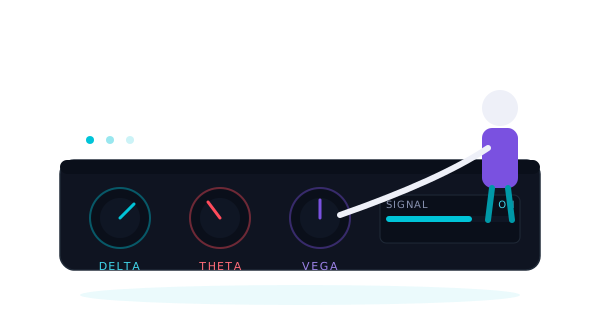
Each Greek answers a different question about your option: how does it react when the stock moves? When a day passes? When volatility rises? They're named after Greek letters because that's what the original math textbooks used and the convention stuck — there's no deeper meaning to the names, and you don't need a maths background to use them. Each one fits in a single sentence, and the dashboard analogy holds almost perfectly: think of the Greeks as gauges on a car's instrument panel. You glance at them, you don't stare.
Delta — the steering wheel
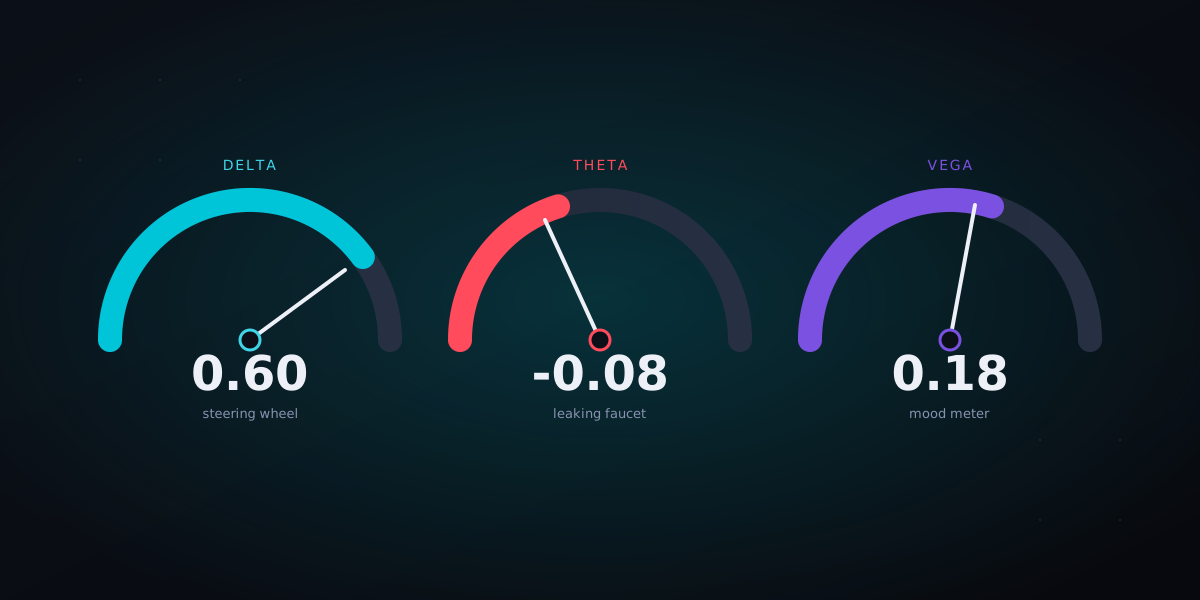
Delta tells you how much the option's price changes when the stock moves $1, expressed as a number between 0 and 1 for calls (and 0 to −1 for puts).
A 0.40 delta call goes up roughly $0.40 for every dollar the stock gains and loses about the same when it falls. Deep in-the-money calls have deltas approaching 1.00 — they move almost dollar-for-dollar with the stock — while far out-of-the- money calls sit closer to 0.10, barely budging on a $1 move. Delta also doubles as a rough probability of the option finishing in-the-money, so a 0.40 delta is loosely “a 40% shot at hitting” — the math isn't exact but the intuition is close enough that traders use the two readings interchangeably when picking strikes.
Theta — the leaking faucet
Theta is how much the option loses each day just because another day has passed — a faucet slowly draining the bathtub even when nothing else is happening to the stock.
Even if the stock sits perfectly still, you wake up tomorrow with a slightly less valuable option, and the day after with less still. Theta is small when expiry is far away and accelerates dramatically as expiry approaches — a 60-day option might lose two or three cents a day, while the same option with a week to go can lose ten or fifteen. This is why short-dated options feel cheap until you hold one through a quiet weekend and watch your premium drain on a stock that didn't move an inch. The buyer of an option fights theta the entire time they hold it; the seller is on the right side of that drip and is essentially renting out time itself.
Vega — the mood meter
Vega measures how much your option's price moves when implied volatility changes by 1 percentage point — the dial that catches you whenever the chain's mood shifts before the stock has actually done anything.
If the market suddenly gets nervous about a stock — earnings on the calendar, a regulatory question floating around — IV climbs and your options gain value through vega even though the underlying stock didn't budge. Conversely, the morning after earnings the chain decompresses and IV crushes back down, which is why so many traders buy calls before earnings, get the direction right, and still finish red. Vega was working against them long before the stock got the memo. New traders usually learn vega the hard way; once you've lost a trade to volatility crush, you start checking the IV column on the chain before the price column.
Gamma and rho — safely ignored at first
Gamma and rho are real Greeks that show up on every options chain, but they barely matter for a beginner running 30-to-45- day trades on liquid stocks.
Gamma measures how fast delta itself is changing — how sensitive your option's steering is to small stock moves — and matters mostly to active traders rebalancing positions through a fast-moving market. Rho measures how the option price responds to changes in the risk-free interest rate, which on a 30-day option is essentially noise; the move in your premium from a Fed quarter-point cut is dwarfed by what theta does in a single afternoon. Save them for later. The only thing worth knowing about gamma on day one is that it gets bigger as expiry approaches and bigger near at-the-money strikes — a useful intuition for why short-dated near-the-money options feel jumpy even though their deltas haven't moved much.
See them on a live chain
Every broker shows the Greeks on the options chain as toggleable columns next to the bid/ask — and seeing the numbers move in real time is the fastest way to internalise what each one does.
Read the options chain walkthrough if you haven't already — it covers which columns matter on day one and where the Greeks live in the layout. Then pull up a chain on a stock you know, toggle the Greeks on, and watch what happens to delta when the stock ticks up by a dollar, what theta does as the day rolls on, and what vega does when an unexpected headline crosses the wire. The numbers will start to feel like dials rather than abstractions within a couple of sessions.