
Why strike picking matters more than you think
The strike you pick on an options trade decides almost everything — your max profit, your break-even, the probability the trade pays out, and how much premium you collect or pay. Two traders running the same strategy on the same stock with the same expiry can have completely different outcomes purely because they chose different strikes.
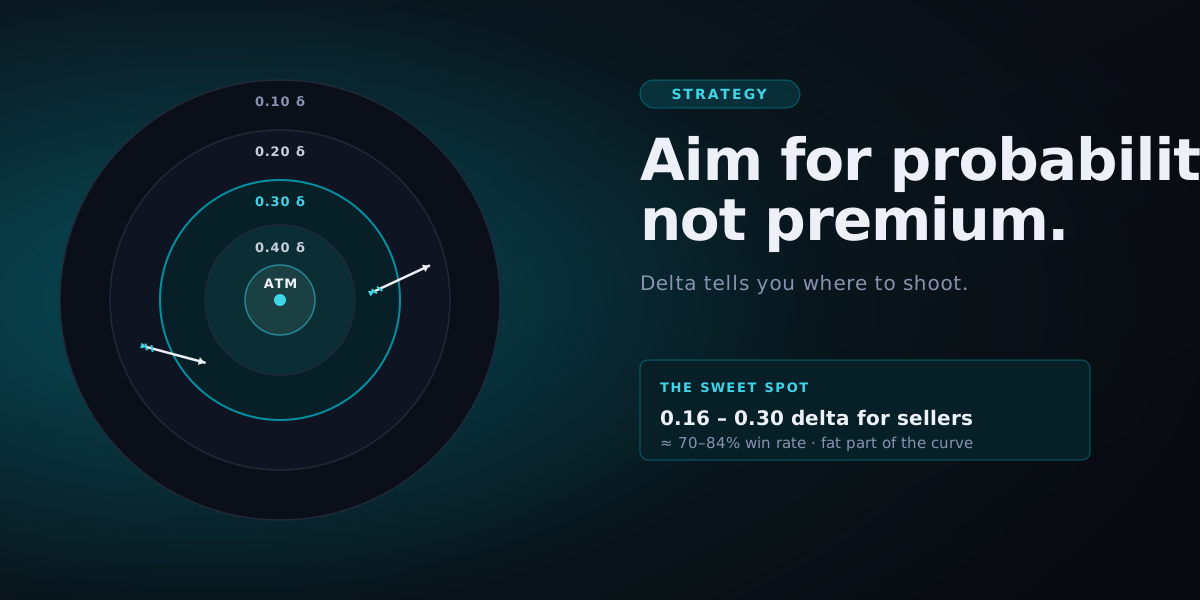
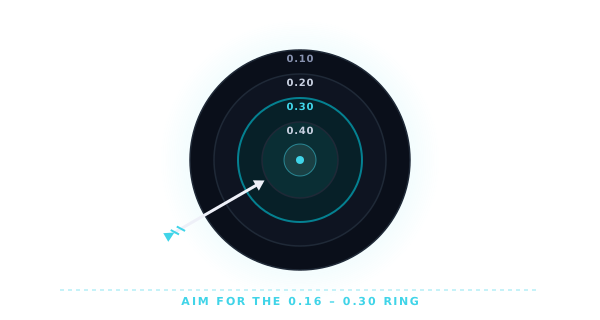
Think of an archery target. The bullseye sits right at the current stock price — at-the-money. Each ring outward is a strike progressively further away. Hitting the bullseye is easy; hitting the outermost ring is hard; and the scoring is rigged so the harder hits pay more. Where you aim depends on what you're trying to do — collect a small fee for a likely outcome, or risk a lot of misses for one occasional big score. The same stock, the same chain, fifteen different strikes, fifteen different trades.
Most retail traders pick strikes by glancing at premium and getting tempted by the biggest number on the screen. That's a recipe for accidental gambling. The framework in this article flips the order — pick the probability you want first, then look at the premium it pays.
Delta as a probability shortcut
Delta is the closest thing options have to a published probability — a 0.30 delta call has roughly a 30% chance of finishing in-the-money at expiration, a 0.50 delta is roughly a coin flip, and a 0.10 delta is a long-shot.
Delta does two jobs on every options chain. The first is the one the Greeks article covered: it tells you how much the option's price moves per $1 move in the underlying. The second is the one that matters for strike picking: delta approximates the probability the option expires in the money. The math isn't exact — there's a small wedge between delta and the true probability that depends on implied volatility — but it's close enough that almost every options trader uses delta as their working probability number.
For puts, the convention is to read the absolute value the same way: a 0.30 delta put (technically −0.30) means a roughly 30% chance of finishing ITM. From here on out everything in this article speaks in absolute deltas; flip the sign in your head if you're working on the put side.
The framework: pick your probability first
The simplest strike-picking framework is to decide what probability of success you want first, then choose the strike whose delta matches it.
That sentence inverts how beginners usually approach the chain. Beginners look at strikes — $95? $100? $105? — see the premium, and gravitate toward whichever number looks biggest. Experienced traders look at deltas first — 0.30? 0.20? 0.16? — see the implied probability of success, and pick the strike whose delta matches their strategy and risk tolerance. The premium falls out of the chain automatically once the delta is chosen; the question becomes “is this premium worth this probability?” rather than “which strike is the cheapest?”
The probability you should want depends on whether you're selling premium or buying it, and we'll take those two camps separately because they require different deltas and different mental models.
Premium sellers: aim for 0.16 to 0.30 delta
For premium-selling strategies — covered calls, cash-secured puts, credit spreads, iron condors — the sweet spot is selling strikes with a delta between 0.16 and 0.30, which corresponds to roughly a 70-84% chance the option expires worthless and you keep the entire premium.
This is the tastytrade-popularised convention and the closest thing the retail options world has to a default. The arithmetic is straightforward: a 0.30 delta short option has a 30% chance of finishing ITM (where you lose) and a 70% chance of finishing OTM (where you win and keep the premium). A 0.16 delta short option flips that to 84%. Stay above 0.30 and you're making a directional bet dressed up as an income trade — the probability of being right is below 70%, the premium looks fat, and the math eventually catches up. Stay below 0.16 and the premium gets too thin to justify the capital you have tied up; the annualised yield drops below what your cash would earn in a Treasury bill.
The cleanest way to translate this into a specific strategy: for a covered call you're selling the call leg, so pick a strike whose delta is between 0.16 and 0.30. For a cash-secured put you're selling the put leg, same delta range. For a credit spread, the short leg is the one whose delta you tune; the long leg sits further OTM as a guardrail. For an iron condor, tune both short strikes in that range, usually symmetrically.
Premium buyers: it's more complicated
For premium-buying strategies — long calls, long puts, debit spreads — there's no universal delta rule because the optimal strike depends on whether you're paying for probability (in-the-money), paying for balance (at-the-money), or paying for leverage (far out-of-the-money).
Three brackets, three different jobs:
- Deep ITM (delta > 0.70):the option trades almost like the stock with less capital. Low leverage, high probability of finishing profitable, but you're paying most of your premium for intrinsic value rather than time value. Good for traders who want stock-like exposure with options-like sizing.
- At-the-money (delta ≈ 0.50):the most balanced trade-off between probability and leverage. About a 50% chance of finishing ITM, the maximum gamma exposure (option price moves accelerate quickly as the stock moves), and the largest theta drag per day. The professional's default when buying directional exposure.
- Far OTM (delta 0.10 to 0.20):lottery tickets. Cheap, asymmetric — when they hit, the percentage return is enormous; when they don't, the entire premium is gone. The sizing rule for this bracket is that the total premium is money you'd be comfortable lighting on fire, because that's the modal outcome.
There's no “right” answer between these three — each is a different bet. The mistake to avoid is treating one bracket like another. People buy 0.10 delta calls and size them like 0.50 delta calls; people buy deep-ITM calls hoping for lottery-ticket returns and discover the leverage was never there.
The probability-premium trade-off
Higher-delta strikes pay more premium (when selling) or have more probability (when buying), but the relationship isn't linear — premium typically falls faster than probability as you move further out-of-the-money.
A concrete example. Suppose you're selling a 30-day call on a $100 stock with mid-range implied volatility. The chain might look something like this: the 0.30 delta strike sells for $2.00 and gives you a 70% win probability. Move out to the 0.20 delta strike — same expiry — and it sells for $1.20 with an 80% win rate. Move further to the 0.10 delta strike and it sells for $0.50 with a 90% win rate. Probability scales 70→80→90 in equal steps, but premium drops $2.00 → $1.20 → $0.50 — much steeper than linear.
The implication is that the fat part of the risk-reward curve sits between roughly 0.16 and 0.30 delta. Below 0.16 the premium gets too thin to be worth the capital; above 0.30 the probability gets too low to call it an income trade. The 16-30 range is where you collect most of the available premium for most of the available probability.
What to actually do
Three rules cover most strike-picking decisions in practice: match the delta to your strategy's intent, sanity-check the premium against the capital, and stop trying to find the “perfect” strike.
Match delta to intent.Selling premium for income? Pick a short strike in the 0.16-0.30 range. Buying directional exposure? Pick 0.30-0.50 if you have conviction, 0.10-0.20 if you're sized as a lottery ticket, >0.70 if you want stock-like exposure with less capital. Don't mix the brackets.
Sanity-check premium against capital.For a premium-selling trade, the annualised yield should comfortably beat your cost of capital — Treasury rates are the floor, your own opportunity cost is the more honest benchmark. If a cash-secured put pays 4% annualised when T-bills pay 5%, you shouldn't be doing the trade; the cash is better off in T-bills. The calculator does this math automatically.
Stop optimising. A 0.25 delta is fine. A 0.27 delta is also fine. A 0.22 delta is fine. There is no perfect strike — anywhere inside your intended bracket is a good decision. Spending an hour comparing the 0.23 strike to the 0.27 strike will not change your long-run results; consistency and discipline will.
Try it with the calculator
The fastest way to internalise the delta-premium curve is to plug different strikes into a calculator and watch the break-even, max profit and annualised yield shift in real time.
Open whichever calculator matches your strategy — the covered-call calculator for an income trade on shares you own, the cash-secured put calculator for paid-to-wait setups, the credit-spread calculator for defined-risk directional plays, or the iron condor calculator for neutral structures — and pick a strike that corresponds to whatever delta you're targeting on the chain. Move the strike $5 closer to the money and watch the premium roughly double; move it $5 further out and watch the annualised yield sag below where T-bills sit. Five minutes of this teaches you more about the trade-off than the rest of this article ever will, and it'll be your decision-making rhythm forever after.